
The feds attacked Minnesota. They will be back.
While the federal forces that attacked Minnesota during Operation Metro Surge have mostly left, many are still here. They are still kidnapping and intimidating residents who fight back. More will return. Please prepare accordingly.
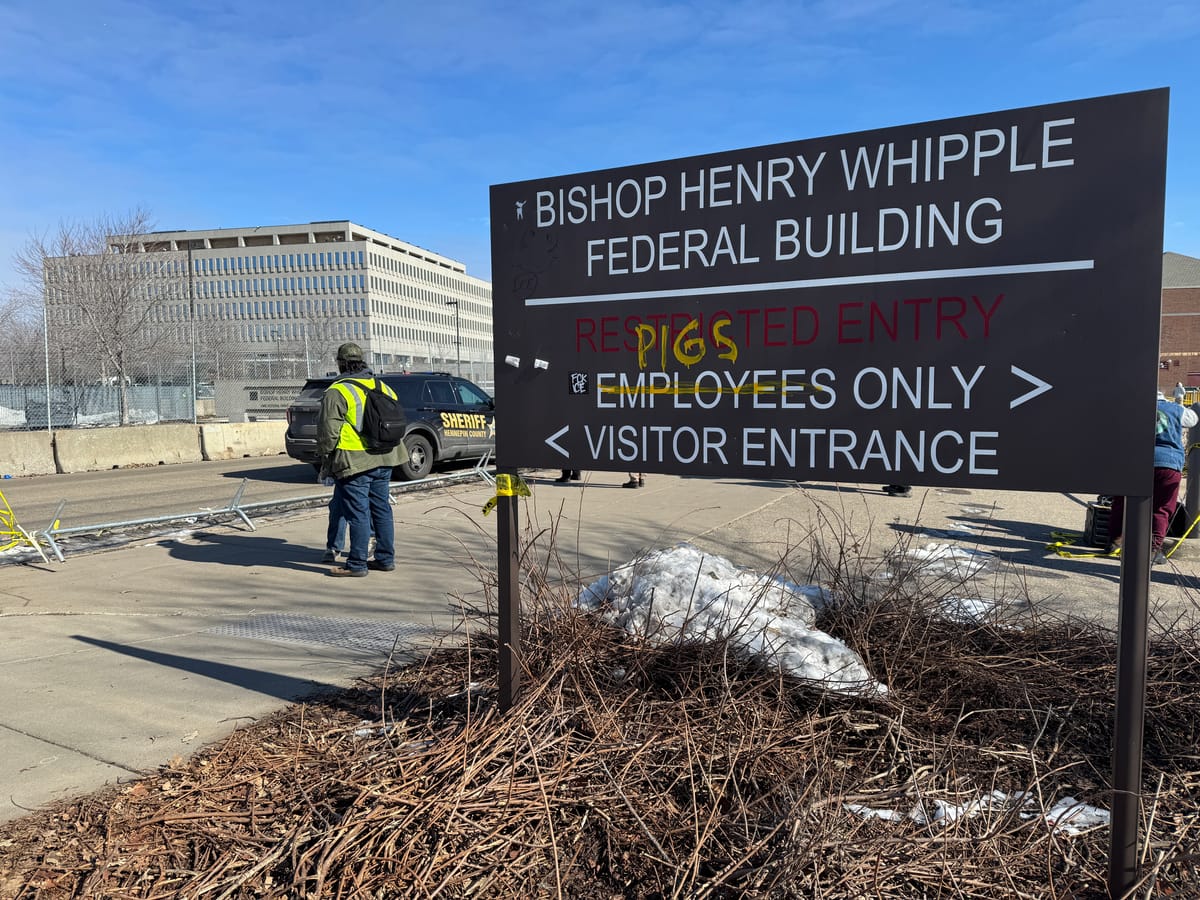
MINNEAPOLIS — Following a drawdown of President Donald Trump’s loyalist forces in Minnesota after Operation Metro Surge, residents remain anxious about the anticipated return to mass state-sanctioned violence in the state.
Operation Metro Surge was billed as an immigration enforcement operation, but in reality, it served as punishment against a state famously hostile to Republican presidents. About 500 agents are still left in the state from a high of about 4,000 in January.
@reportermark This is only a fraction of the violence Department of Homeland Security agents, including ICE and Border Patrol, inflicted on civilians over the course of several days at the Bishop Henry Whipple building located in Ft. Snelling, Minn. The Whipple building is the de facto federal HQ in Minnesota, with several other agencies, including the FBI and the Federal Bureau of Prisons, stationing paramilitary forces loyal to President Donald Trump there. Following this violence, the Hennepin County Sheriff's Office has taken frontline command of the public area next to the Whipple building. Public works employees erected concrete barricades and high fences around the roadway next to the building. Trump's loyalist forces are now mostly seen driving out of the building's parking lot with their faces covered. Since the Sheriff's Office has taken over crowd control, DHS has ramped up it domestic terror campaign against the people in Minnesota. #borderpatrol #minneapolis #ice
♬ original sound - Mark Wasson - Mark Wasson
A compilation video of the federal violence against civilians at the Bishop Henry Whipple Federal Building in Ft. Snelling, Minn.
For many Minnesotans actively involved in defending their neighborhoods from federal agents, mostly from the Department of Homeland Security, the lack of response by local police, politicians and other government entities has created even more distrust in the U.S. political system, which has seen a decline in public trust starting in the 1970s under President Lyndon B. Johnson.
Nationally, only 26% of Republicans, the political party which controls all three branches of the federal government right now, trust the federal government to do what is right, compared to only 9% of Democrats, according to the Pew Research Center.
While the two party system has largely failed to address systemic issues both inside and outside U.S. borders, even local hotbeds of radical politics like Minneapolis have seen their locally controlled security forces like the Minneapolis Police Department actively refuse to protect citizens from the daily onslaught of tear gas and firearms used by federal agents.
For Emily Phillips, an activist organizer in the Twin Cities, her trust in American institutions has fallen much lower after Operation Metro Surge, especially following local police conduct with federal agents.
“I think the dynamic has to change,” she said. “We can’t allow certain people to be in control of who gets resources. We need to take control of that again, and we as a community need to do that."
Phillips, who started out protesting and watching immigration court hearings at the Bishop Henry Whipple Federal Building located in Ft. Snelling late last year, quickly became one of the loudest voices against federal violence during Operation Metro Surge.
With her bright red hair and boisterous voice, Phillips could often be found confronting federal agents at the Whipple building, which serves as the de facto Immigration and Customs Enforcement (ICE) headquarters for the Midwest.
Due to her willingness to fight against authoritarian violence, that violence was consistently turned back onto her, from physical attacks by federal police to a masked agent trying to hit her with his vehicle.
@reportermark Federal agents attacked a woman in front of the Bishop Henry Whipple Building on Jan 9, 2026. #minnesota #dhs #ice @Emily Phillips
♬ original sound - Mark Wasson
Emily Phillips is attacked by federal forces at the Bishop Henry Whipple Federal Building on Jan. 9, 2026.
On Dec. 7, 2025, an ICE agent in Richfield, Minn. boxed in a vehicle Phillips was in and pointed his rifle at her as an act of intimidation, a common tactic by U.S.-backed far-right paramilitary forces across the globe.
“He had his finger on the trigger, and he was shaking when I looked down the barrel of (the rifle),” Phillips said. “He pointed (the rifle) at our heads before he put (the rifle) down, and then him and some other agents took turns yelling in the window at us, trying to open the doors.”
Phillips said this happened to at least three other vehicles in Richfield that day and that local cops wouldn’t let her file a police report.
These tactics eventually led to federal agents killing two Minnesota residents, Renee Good and Alex Pretti, who paid Trump’s price for standing up for their neighbors.
Federal agents were also fond of calling out Phillips' name over their PA systems at the Whipple building while she watched car after car of masked ICE and Customs and Border Patrol agents give her the finger as they drove out of the building’s parking lot.
At some point during the surge, possibly due to bad optics, agents moved away from angry gestures as they exited the building and started blowing kisses or giving “heart hands."
“It's really weird when there are masked men that you know abduct people, blowing kisses at you or giving heart hands with the same hands they beat people with,” Phillips said.
INSTITUTIONAL FAILURES
With few exceptions, Minnesota-based systems like the courts, police and local government failed at keeping the public safe from the lawless state-sanctioned paramilitary force that descended on Minnesota months ago.
Courts, both state and federal, failed to properly sanction government lawyers or fully pursue contempt charges for the regurgitation of lies spewed by federal government officials during the surge.
In fact, one judge found that ICE violated at least 96 court orders in 74 cases. Yet, no federal government official, elected or otherwise, has seen the inside of a jail cell due to their conduct, despite hundreds of civilians being unconstitutionally detained for exercising their First Amendment rights.
While federal agents were caught on camera breaking countless laws, like removing their license plates, driving recklessly and assaulting civilians, local security forces for the most part refused to step in when they were most needed.
Instead, many police agencies and local politicians in Minnesota decided to actively work with Trump’s loyalist forces.
“Every level of police operations is going to be questioned because we saw every level of police cooperate with (federal forces), literally from park police to Veterans Affairs to airport police, all the way up to state troopers,” Phillips said. “There’s no one exempt from questioning as far as what they’re doing on the scene anymore because anytime it could be an immigration stop."
For example, following the killing of Alex Pretti by a Trump federal goon squad, Minneapolis police and state troopers squared off against residents instead of arresting the agents involved in his death.
“I have more hope for Minneapolis than most states,” said Valerie Quintara, a Latina Twin Cities nonprofit activist. “But there’s not been any fucking progress. There’s just been better marketing."
Even Mayor Jacob Frey, a vocal Trump opponent, went on a national speaking tour instead of defending his city.
“He wasn’t anywhere during this,” Taylor Dahlin, a local independent journalist in the Twin Cities said. “It would have been easy for him to put on a safety vest and go do a school patrol, and he didn’t do that.”
While Dahlin praised the coverage from the Sahan Journal and The Racket during Operation Metro Surge, she said the Star Tribune, the state’s largest newspaper, failed to hold Frey accountable.
“I think the media was too accepting of his methods and how he spent his time,” Dahlin said. “It seemed like he was raising his national profile and (the media) didn’t want to address that.”
Dahlin also found fault with national news outlets and social media streamers that came to town for the violence but quickly left, leaving a grieving and heavily traumatized community to fend on its own, a tactic commonly referred to as parachute journalism.
She highlighted an incident where she called out one streamer who referred to a man getting shot by federal agents in North Minneapolis on Jan. 14 as the “action.”
“That’s the same night a six-month-old baby got tear gassed,” Dahlin said. “That really just kind of crystalized to me how these streamers look at it. They don’t live here. They parachute in and they get to run around and pretend this is their war zone assignment.”
In St. Paul, a reliably blue city, local cops helped federal agents tear gas, mace and pepper ball residents during a November 2025 house raid, which forced Melvin Carter, the city’s mayor at the time, to respond to the site in response to the brutality of his police force. He said he was unaware of the operation.
Perhaps St. Paul voters recently replacing Carter with Mayor Kaohly Her earlier that month had something to do with his lackluster response.
@reportermark ST. PAUL - Paramility forces loyal to President Trump attacked community members as they protested a Department of Homeland Security raid at a St. Paul residence on Nov. 25, 2025. Members of the St. Paul Police Department, a local security force under the control of Mayor Melvin Carter, also attacked community members. This is the second time this month that police have attacked community members attempting to stop masked paramilitary forces being deployed in the city. *Note* Sorry for the text on screen towards the end. I'm still learning how to use Tik Tok and I am old and stupid. #minnesota #ice #dhs #stpaul
♬ original sound - Mark Wasson - Mark Wasson
Federal and local police violence against civilians in St. Paul on Nov. 25, 2025.
In addition to coordinated operations, federal agents have called local police to report civilians observing their activity, which typically gets a response by local security forces. This causes local cops to act, essentially, as bodyguards for people breaking state, federal and international law.
This may be due to how federal laws are written, according to Minnesota State Rep. Brad Tabke, who represents a southwest metro district comprised mostly of the city of Shakopee.
“I’m not saying that people don’t have reasons for being frustrated with law enforcement and those kinds of things," Tabke said. “But (local cops) were also stuck between a rock and a hard place."
Many of the federal laws currently in place were written with the assumption that the federal government is a partner and not an adversary, according to Tabke, who spent much of Operation Metro Surge helping his community track and observe federal agents.
Simply put, there’s no legal game plan regarding a federal invasion of an American community.
Despite some police agencies receiving a fair bit of criticism for their actions in support of federal operations in the state, Tabke said he was proud of how the Shakopee Police Department handled ICE.
For example, when local police showed up to places ICE was at in Shakopee, ICE would generally just leave, Tabke said.
“ICE had no plan, no real reason for being there, other than to harass and create fear and intimidation,” Tabke said. “It was a terrible coordinated effort they were doing, and our local law enforcement was not playing that game with them."
In response to the lawlessness of Trump’s forces, Tabke said democrats in the state are reviewing local laws and seeing what can be done for the future.
One answer is a set of bills authored by Tabke to reduce law enforcement and private access to automated license plate readers around the state.
HF 3856 would require law enforcement to destroy any license plate reader technology it owns and any of the relevant data gathered by that system. It would also require a warrant before accessing any license plate reader data provided by a private company.
HF 4205 would require all owners of those license plate readers to send its data to the Minnesota Bureau of Criminal Apprehension and would restrict its usage outside of a court order or judicial warrant.
There are over 300 license plate cameras in the Twin Cities metro area alone, according to LPR Maps, a community platform that maps license plate readers across the country.
Automatic license plate readers are able to track vehicles, not just by their license plates, but also by distinct markings on the car, who might be driving it and what they might be doing.
Local cops from around the country have made over 4,000 searches in Flock’s AI-powered license plate reader database for the federal government, many with an immigration focus, according to 404 Media.
The Department of Homeland Security also uses license plate scanning cameras at the border.
Flock Group Inc., the massive surveillance company that owns the Flock license plate readers, sells its spy cameras to police, neighborhood associations and private property owners. The company says they have cameras in 5,000 communities in 49 states. The system does about 20 billion scans a month.
Both bills that seek to put safeguards around that surveillance system are currently stuck in the Minnesota House Judiciary Committee following state Republican opposition.
Following the far-right capture and heavy influence in Republican and Democrat politics, an increase in state-sanctioned violence against civilians, a worsening economy and several military strikes by the U.S. across the world, the fear of more to come is at the forefront of many Minnesotans minds.
“The old system doesn’t work for the vast majority of us and those of us that speak out against it,” Phillips said. “They’re building those concentration camps for someone and if they’re deporting people, who are they going to put there?"
ICE is currently pursuing a $45 billion expansion for its detention centers across the country that has been shrouded in secrecy.
Its last concentration camp built in haste under Trump’s tenure, affectionately called Alligator Alcatraz by Trump’s far-right cabinet and civilian supporters, has been accused by Amnesty International of torture and enforced disappearances at its Florida site.
While the federal forces that attacked Minnesota during Operation Metro Surge have mostly left, many are still here. They are still kidnapping and intimidating residents who fight back. More will return. Please prepare accordingly.

Comments ()